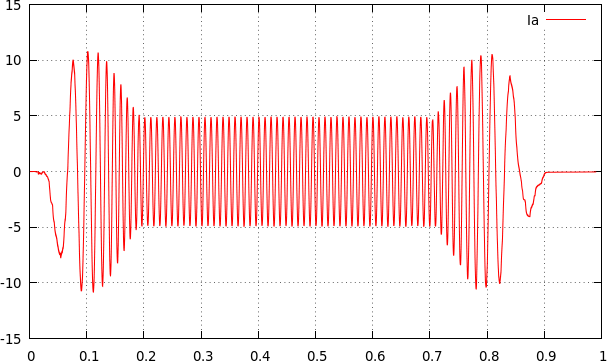
 There has been many papers devoted to the analysis and implementation of high performance AC Brushless motor control algorithms and control techniques. Most emphasize a state-space approach using a combination of feedforward and feedback linearization along with transformations, to reduce the plant to a set of simple first order differential equations.
Within this new basis, the control reduces to a simple set of linear time-invariant equations. One such approach, elegant in it’s method of plant reduction, is presented here. More importantly, this paper suggests an approach to the design and implementation of a networked drive and control system using a custom simulation environment that allows not only the motor and control algorithms to be modeled, but the characteristics of the drive electronics as well. The input to this simulator is in the form of a behavioral model of the controller and at in it’s final stage the actual C language code that would be placed in the various processing units of the control hardware. During all stages of development, the plant(motor, switching amplifier, and feedback transducers) is presented as a
near exact mathematical model of the physical system. For the physical design of the drive and associated control hardware, the stress here is to choose components that minimize the size and cost of the drive and at the same time maximize it’s performance and reliability. This document also presents information on the additional benefits of 3-Level (neutral point clamp) modulation compared to traditional 2-Level modulation.
More information on this can be found here.
This paper includes information on the benefits of Space Vector (SV) PWM as it relates to control of a servo motor.
Another paper is presented that provides information on minus side referenced SVPWM characteristics combined with switching dead time compensation, which can be found here.
Dead-time elimination in SVPWM Mode
Also, a paper describing periodic disturbance compensation relative to motor control using numerical calculation methods. Similar to the papers above, full simulation is performed using Space Vector PWM to control the motor.
Disturbance Compensation based on Numerical Modeling
There is an additional benefit of SV modulation that can be applied to the reduction of current flow to earth ground caused by capacitive coupling between the stator and frame of a motor.
Information on this topic can be found here.
Minimizing the Effects of Common Mode Capacitive Coupling
 MEA Consulting